

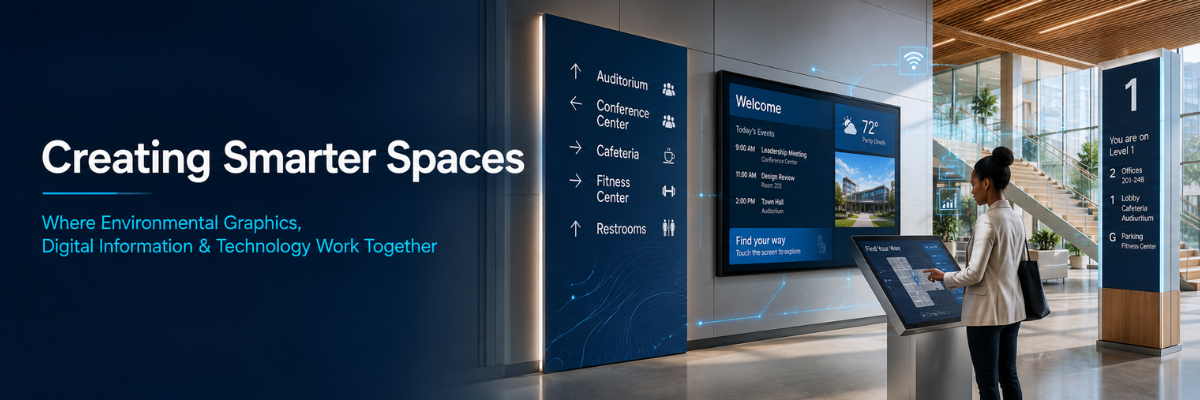
Modern built environments are expected to do more than provide functional spaces. They must help people find their way, access information, understand their surroundings, and interact with facilities more effectively. Achieving this requires organizations to think beyond physical design and consider how environmental graphics, digital information, and connected technologies can work together as part of a cohesive user experience.
When these elements are planned independently, opportunities to improve communication and engagement can be missed. When they are connected strategically, physical spaces can become more intuitive, informative, and responsive to the needs of their users. RPG Squarefoot Solutions helps organizations explore how environmental graphics, digital content, and technology can come together to create more connected and intelligent experiences across the built environment. This post explores how these elements complement one another and why their convergence is becoming increasingly important for modern spaces.
Understanding Environmental Graphics
Environmental graphics integrate graphic design with the built environment to communicate information, support navigation, and reinforce the identity of a physical space. Unlike standalone signs, they combine visual communication with architectural elements to create organized, informative, and visually cohesive environments that help people understand and interact with their surroundings more effectively. When thoughtfully planned, environmental graphics become part of the overall information experience, helping people understand where they are, where they need to go, and what they need to know.
Environmental graphics enhance user experiences by:
- Improving Wayfinding: Clear directional graphics, identification signs, and location markers help people navigate unfamiliar environments more confidently, reducing confusion and supporting the efficient flow of movement throughout a facility.
- Supporting Accessibility: Legible typography, appropriate color contrast, universally recognized symbols, and tactile graphic elements help create more inclusive environments that support users with diverse accessibility needs.
- Increasing Engagement: Branded graphics, interpretive displays, and experiential visual elements can make information more engaging while reinforcing an organization's identity, values, and messaging.
Their role extends beyond aesthetics. Environmental graphics provide a physical layer of communication that can work alongside digital information and technology to create more consistent and intuitive experiences across a facility.
The Evolution of Communication in Physical Spaces
While traditional environmental graphics continue to provide essential visual communication, organizations increasingly combine them with digital and interactive solutions to deliver more responsive, adaptable, and informative environments. The shift is not about replacing one form of communication with another. Instead, it is about combining different communication layers to address both permanent and changing information needs.
The evolution can be understood through three key stages:
- Static Signage: Physical signs formed the foundation of communication within the built environment, providing permanent information for identification, direction, branding, safety, and regulatory compliance. While highly effective for fixed messaging, they could not easily accommodate changing information.
- Digital Information Displays: As organizations required more flexible communication, digital displays emerged to complement static signage by delivering dynamic content such as announcements, schedules, visitor information, room availability, and emergency notifications. Their ability to update content instantly enabled facilities to communicate changing information without replacing physical graphics.
- Interactive Communication: The next stage of evolution introduced greater user interaction through touchscreen directories, self-service kiosks, QR-enabled experiences, and digital wayfinding solutions. Rather than simply displaying information, these technologies allow users to access personalized content, navigate complex environments, and interact with spaces more intuitively.
Today, modern built environments bring these approaches together rather than treating them as separate communication systems. Environmental graphics provide permanent visual guidance, digital information systems communicate changing content, and connected technologies enable information to be coordinated across different user touchpoints. This integrated approach helps organizations create more consistent, responsive, and intuitive experiences while supporting the operational needs of the facility.
Industry Applications of Environmental Graphics
Here are some of the most common environments where environmental graphics, digital information, and connected technologies work together to improve communication, navigation, and overall user experience:
- Corporate Offices: Support workplace communication, reinforce brand identity, guide visitors, and improve navigation across dynamic workspaces where room availability, employee information, and other content may change frequently.
- Healthcare Facilities: Help patients, visitors, and staff navigate complex campuses while supporting communication, departmental identification, wayfinding, accessibility, and access to timely facility information.
- Educational Campuses: Improve campus navigation, communicate academic and event information, and create cohesive learning environments while helping students, faculty, and visitors move between buildings and shared spaces more efficiently.
- Retail Environments: Combine branded graphics with digital communication to guide customers, communicate product information, and support a more consistent experience across physical and digital touchpoints.
- Transportation Hubs: Deliver clear directional guidance, real-time travel information, and consistent communication to support passenger movement in environments where schedules, routes, and other critical information can change quickly.
Explore RPG’s Graphics Equipment Solutions
As environmental graphics become part of broader communication experiences, organizations also need reliable production capabilities to deliver consistent, high-quality visual elements across different spaces and applications. Precision printing, accurate cutting, dependable finishing, and efficient workflows all play a role in translating creative concepts into finished environmental graphics.
RPG Squarefoot Solutions provides advanced graphics equipment, including wide-format printers, CNC flatbed and XY cutters, applicators, laminators, and integrated workflow solutions designed to support efficient and precise graphics production. Explore our Graphics Equipment Solutions to discover technologies that can help bring environmental graphics from concept to installation while supporting the communication needs of modern built environments.
Blog Latest Posts
Modern built environments are expected to do more than provide functional spaces. They must help people find their way, access information, understand their surroundings, and interact with facilities more effectively. Achieving this requires organizations to think beyond physical design and consider how environmental graphics, digital information, and connected technologies can work together as part of a cohesive user experience.
When these elements are planned independently, opportunities to improve communication and engagement can be missed. When they are connected strategically, physical spaces can become more intuitive, informative, and responsive to the needs of their users. RPG Squarefoot Solutions helps organizations explore how environmental graphics, digital content, and technology can come together to create more connected and intelligent experiences across the built environment. This post explores how these elements complement one another and why their convergence is becoming increasingly important for modern spaces.
Understanding Environmental Graphics
Environmental graphics integrate graphic design with the built environment to communicate information, support navigation, and reinforce the identity of a physical space. Unlike standalone signs, they combine visual communication with architectural elements to create organized, informative, and visually cohesive environments that help people understand and interact with their surroundings more effectively. When thoughtfully planned, environmental graphics become part of the overall information experience, helping people understand where they are, where they need to go, and what they need to know.
Environmental graphics enhance user experiences by:
- Improving Wayfinding: Clear directional graphics, identification signs, and location markers help people navigate unfamiliar environments more confidently, reducing confusion and supporting the efficient flow of movement throughout a facility.
- Supporting Accessibility: Legible typography, appropriate color contrast, universally recognized symbols, and tactile graphic elements help create more inclusive environments that support users with diverse accessibility needs.
- Increasing Engagement: Branded graphics, interpretive displays, and experiential visual elements can make information more engaging while reinforcing an organization's identity, values, and messaging.
Their role extends beyond aesthetics. Environmental graphics provide a physical layer of communication that can work alongside digital information and technology to create more consistent and intuitive experiences across a facility.
The Evolution of Communication in Physical Spaces
While traditional environmental graphics continue to provide essential visual communication, organizations increasingly combine them with digital and interactive solutions to deliver more responsive, adaptable, and informative environments. The shift is not about replacing one form of communication with another. Instead, it is about combining different communication layers to address both permanent and changing information needs.
The evolution can be understood through three key stages:
- Static Signage: Physical signs formed the foundation of communication within the built environment, providing permanent information for identification, direction, branding, safety, and regulatory compliance. While highly effective for fixed messaging, they could not easily accommodate changing information.
- Digital Information Displays: As organizations required more flexible communication, digital displays emerged to complement static signage by delivering dynamic content such as announcements, schedules, visitor information, room availability, and emergency notifications. Their ability to update content instantly enabled facilities to communicate changing information without replacing physical graphics.
- Interactive Communication: The next stage of evolution introduced greater user interaction through touchscreen directories, self-service kiosks, QR-enabled experiences, and digital wayfinding solutions. Rather than simply displaying information, these technologies allow users to access personalized content, navigate complex environments, and interact with spaces more intuitively.
Today, modern built environments bring these approaches together rather than treating them as separate communication systems. Environmental graphics provide permanent visual guidance, digital information systems communicate changing content, and connected technologies enable information to be coordinated across different user touchpoints. This integrated approach helps organizations create more consistent, responsive, and intuitive experiences while supporting the operational needs of the facility.
Industry Applications of Environmental Graphics
Here are some of the most common environments where environmental graphics, digital information, and connected technologies work together to improve communication, navigation, and overall user experience:
- Corporate Offices: Support workplace communication, reinforce brand identity, guide visitors, and improve navigation across dynamic workspaces where room availability, employee information, and other content may change frequently.
- Healthcare Facilities: Help patients, visitors, and staff navigate complex campuses while supporting communication, departmental identification, wayfinding, accessibility, and access to timely facility information.
- Educational Campuses: Improve campus navigation, communicate academic and event information, and create cohesive learning environments while helping students, faculty, and visitors move between buildings and shared spaces more efficiently.
- Retail Environments: Combine branded graphics with digital communication to guide customers, communicate product information, and support a more consistent experience across physical and digital touchpoints.
- Transportation Hubs: Deliver clear directional guidance, real-time travel information, and consistent communication to support passenger movement in environments where schedules, routes, and other critical information can change quickly.
Explore RPG’s Graphics Equipment Solutions
As environmental graphics become part of broader communication experiences, organizations also need reliable production capabilities to deliver consistent, high-quality visual elements across different spaces and applications. Precision printing, accurate cutting, dependable finishing, and efficient workflows all play a role in translating creative concepts into finished environmental graphics.
RPG Squarefoot Solutions provides advanced graphics equipment, including wide-format printers, CNC flatbed and XY cutters, applicators, laminators, and integrated workflow solutions designed to support efficient and precise graphics production. Explore our Graphics Equipment Solutions to discover technologies that can help bring environmental graphics from concept to installation while supporting the communication needs of modern built environments.