

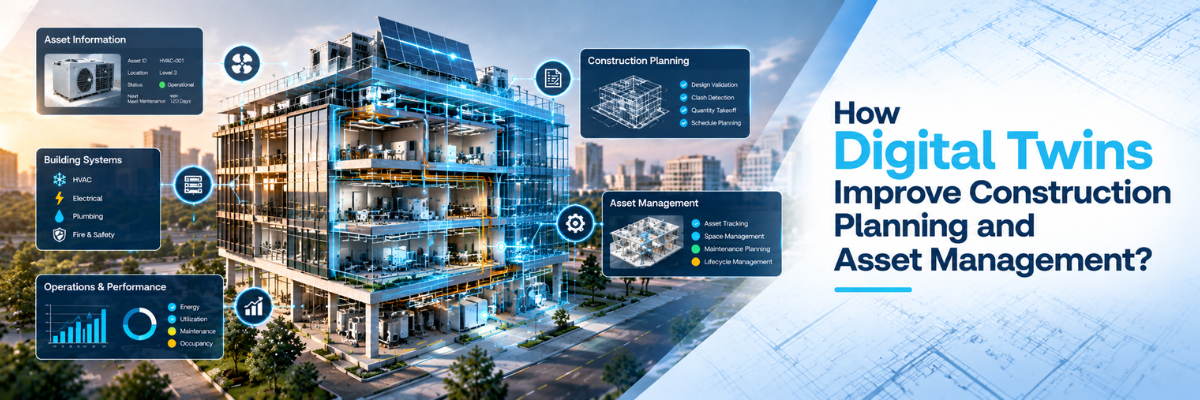
Construction projects generate large amounts of information across design, construction, and operations, but that information is often stored across separate models, drawings, field records, and asset systems. When these sources remain disconnected, teams can struggle to understand current conditions, coordinate project activities, and access reliable asset information after handover. Digital Twins provide a way to bring these information sources together within a connected digital environment. RPG Squarefoot Solutions helps organizations develop Digital Twin environments that integrate reality capture, Building Information Modeling (BIM), asset information, and operational data. In this post, we explore how Digital Twins can support construction planning and asset management throughout the asset lifecycle.
From Building Information Modeling (BIM) to Digital Twin
BIM provides structured information about building components and systems during design and construction. A Digital Twin builds on this foundation by connecting BIM with reality capture, asset information, and operational data.
This creates a broader information environment that can continue to support the asset beyond design and construction. Instead of using BIM primarily as a project delivery resource, organizations can connect project information with operational requirements and asset data for ongoing use.
How Digital Twins Improve Construction Planning
During construction, teams need to coordinate design information with actual site conditions and planned work. A Digital Twin can bring these sources together to support planning activities before and during project execution.
Key applications include:
- Existing-Condition Review: Reality capture data can be compared with design information to help teams understand existing conditions before construction or modification work begins.
- Design Coordination: Connected spatial information can help teams review relationships between architectural, structural, and MEP elements.
- Construction Sequencing: Project teams can use a shared digital environment to review planned work areas and coordinate activities across trades.
- Change Evaluation: When project conditions or designs change, connected information can help teams assess affected areas before making implementation decisions.
How Digital Twins Support Asset Management
Once construction is complete, the same connected information can support facility teams. Rather than rebuilding asset information from project records, organizations can maintain relevant data within a digital environment that reflects the physical facility.
Digital Twins can support:
- Asset Identification: Facility teams can associate equipment and building components with their location and relevant asset information.
- Maintenance Planning: Asset records and operational information can support planning for inspections, servicing, and maintenance activities.
- Facility Modifications: Teams can reference existing spatial and asset information when planning renovations, expansions, or system changes.
- Handover and Documentation: Connected project information can provide a more structured foundation for transferring relevant data from construction teams to facility operators.
Where Digital Twins Deliver the Most Value
Digital Twins can be particularly useful for assets with complex systems, large physical footprints, or long operating lifecycles.
- Commercial and Complex Facilities: Large buildings with extensive architectural, structural, and MEP systems can benefit from centralized project and asset information.
- Industrial Environments: Manufacturing and processing facilities can use Digital Twins to connect spatial information with equipment and operational data.
- Infrastructure Projects: Transportation and other infrastructure assets can benefit from digital environments that support planning, inspection, maintenance, and future modifications.
Connecting Reality Capture, BIM and Digital Twins
Reality capture provides an important link between the physical asset and its digital representation. Laser scanning can document existing conditions, while Scan to BIM workflows convert captured information into structured models.
These models can then be connected with BIM information, asset records, and operational systems to establish the information foundation for a Digital Twin. The result is a digital environment that can be updated and used across different stages of the asset lifecycle.
Why Consider a Digital Twin?
The business case for a Digital Twin depends on how effectively an organization can use its information across project and operational activities. For many organizations, the value comes from maintaining continuity between information that would otherwise remain separated.
A Digital Twin can help organizations:
- Reduce Information Gaps: Bring relevant project, spatial, and asset information into a common environment.
- Support Better Planning: Give teams a stronger information base for evaluating construction activities and facility changes.
- Extend the Value of Project Data: Continue using information created during design and construction after the asset becomes operational.
Improve Construction Planning and Asset Management
Digital Twins provide a practical way to connect information across design, construction, and operations. By bringing relevant project, spatial, asset, and operational data together, they can help teams plan work more effectively and manage facilities with better access to the information they need.
Explore Digital Twin Solutions to see how a connected digital environment can support your construction planning and asset management goals.
Blog Latest Posts
Construction projects generate large amounts of information across design, construction, and operations, but that information is often stored across separate models, drawings, field records, and asset systems. When these sources remain disconnected, teams can struggle to understand current conditions, coordinate project activities, and access reliable asset information after handover. Digital Twins provide a way to bring these information sources together within a connected digital environment. RPG Squarefoot Solutions helps organizations develop Digital Twin environments that integrate reality capture, Building Information Modeling (BIM), asset information, and operational data. In this post, we explore how Digital Twins can support construction planning and asset management throughout the asset lifecycle.
From Building Information Modeling (BIM) to Digital Twin
BIM provides structured information about building components and systems during design and construction. A Digital Twin builds on this foundation by connecting BIM with reality capture, asset information, and operational data.
This creates a broader information environment that can continue to support the asset beyond design and construction. Instead of using BIM primarily as a project delivery resource, organizations can connect project information with operational requirements and asset data for ongoing use.
How Digital Twins Improve Construction Planning
During construction, teams need to coordinate design information with actual site conditions and planned work. A Digital Twin can bring these sources together to support planning activities before and during project execution.
Key applications include:
- Existing-Condition Review: Reality capture data can be compared with design information to help teams understand existing conditions before construction or modification work begins.
- Design Coordination: Connected spatial information can help teams review relationships between architectural, structural, and MEP elements.
- Construction Sequencing: Project teams can use a shared digital environment to review planned work areas and coordinate activities across trades.
- Change Evaluation: When project conditions or designs change, connected information can help teams assess affected areas before making implementation decisions.
How Digital Twins Support Asset Management
Once construction is complete, the same connected information can support facility teams. Rather than rebuilding asset information from project records, organizations can maintain relevant data within a digital environment that reflects the physical facility.
Digital Twins can support:
- Asset Identification: Facility teams can associate equipment and building components with their location and relevant asset information.
- Maintenance Planning: Asset records and operational information can support planning for inspections, servicing, and maintenance activities.
- Facility Modifications: Teams can reference existing spatial and asset information when planning renovations, expansions, or system changes.
- Handover and Documentation: Connected project information can provide a more structured foundation for transferring relevant data from construction teams to facility operators.
Where Digital Twins Deliver the Most Value
Digital Twins can be particularly useful for assets with complex systems, large physical footprints, or long operating lifecycles.
- Commercial and Complex Facilities: Large buildings with extensive architectural, structural, and MEP systems can benefit from centralized project and asset information.
- Industrial Environments: Manufacturing and processing facilities can use Digital Twins to connect spatial information with equipment and operational data.
- Infrastructure Projects: Transportation and other infrastructure assets can benefit from digital environments that support planning, inspection, maintenance, and future modifications.
Connecting Reality Capture, BIM and Digital Twins
Reality capture provides an important link between the physical asset and its digital representation. Laser scanning can document existing conditions, while Scan to BIM workflows convert captured information into structured models.
These models can then be connected with BIM information, asset records, and operational systems to establish the information foundation for a Digital Twin. The result is a digital environment that can be updated and used across different stages of the asset lifecycle.
Why Consider a Digital Twin?
The business case for a Digital Twin depends on how effectively an organization can use its information across project and operational activities. For many organizations, the value comes from maintaining continuity between information that would otherwise remain separated.
A Digital Twin can help organizations:
- Reduce Information Gaps: Bring relevant project, spatial, and asset information into a common environment.
- Support Better Planning: Give teams a stronger information base for evaluating construction activities and facility changes.
- Extend the Value of Project Data: Continue using information created during design and construction after the asset becomes operational.
Improve Construction Planning and Asset Management
Digital Twins provide a practical way to connect information across design, construction, and operations. By bringing relevant project, spatial, asset, and operational data together, they can help teams plan work more effectively and manage facilities with better access to the information they need.
Explore Digital Twin Solutions to see how a connected digital environment can support your construction planning and asset management goals.