

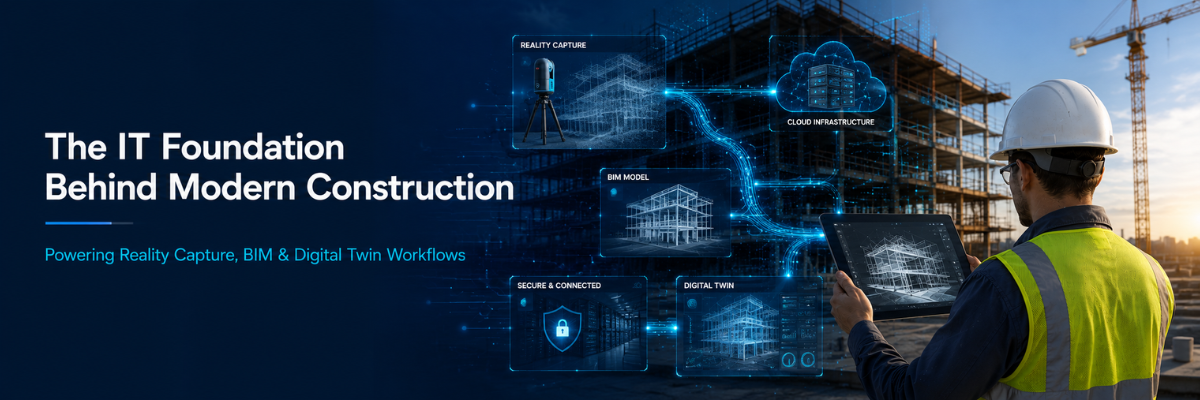
Most construction technology conversations today focus on tools. Reality capture, BIM platforms, cloud collaboration software, and digital twins are becoming standard as these technologies improve visibility, coordination, and decision making. However, they also introduce a challenge that many firms overlook. The challenge isn’t the software itself, but the infrastructure supporting it. As construction workflows become increasingly data-driven, firms generate, store, and share far more information than traditional systems were designed to handle. Large point clouds, BIM models, sensor data, and project files all place significant demands on storage, security, connectivity, and performance. That’s why a strong IT foundation matters. RPG’s CompleteIT supports construction companies with managed IT services designed to keep modern construction technology running efficiently, securely, and reliably.
This post explores how construction technology is changing infrastructure requirements, where common challenges appear, and why managed IT plays an important role in supporting BIM, Reality Capture, and digital twin workflows.
Construction Technology Creates New Infrastructure Demands
Modern construction operations rely on multiple digital systems working together. However, this increases the demand for storage capacity, network performance, cybersecurity, and system reliability.
- Reality Capture: Technologies such as Leica laser scanners and drone photogrammetry collect highly detailed site information and generate large point cloud datasets.
- BIM platforms: BIM software converts site data into coordinated 3D models used by architects, engineers, contractors, and project teams throughout the project lifecycle.
- Cloud collaboration: Cloud-based platforms allow teams in different offices and project locations to access the same files and models without relying on manual file transfers.
- Digital Twins: Digital twins combine BIM data with live operational information, creating continuously updated models that reflect real-world asset conditions.
Challenges: Where Infrastructure Limitations Appear
Here are some common challenges that emerge.
- Storage limitations: Point clouds, BIM models, and project archives consume large amounts of storage space and continue growing across projects.
- Slow file performance: Large models may take longer to open, load, or synchronize, creating delays during coordination meetings and design reviews.
- Security risks: Project files often contain sensitive client information, site documentation, and compliance-related records that require stronger protection.
- Accessibility issues: Field teams need reliable access to project data on-site, while office teams require immediate access to the same information from different locations.
- Scalability concerns: As firms expand their use of reality capture and digital twin technology, outdated infrastructure can quickly become a bottleneck.
Benefits of Managed IT Services
Managed IT services help construction firms build the infrastructure needed to support modern project delivery. Here are some key benefits.
- Reliable system performance: Teams can access BIM models, project files, and cloud applications without unnecessary interruptions.
- Improved cybersecurity: Strong security controls help protect project information, client records, and operational data from cyber threats.
- Better collaboration: Remote teams can review scans, models, and project information quickly without waiting for large file transfers.
- Reduced downtime: Stable infrastructure minimizes disruptions that can delay coordination, planning, and execution activities.
- Scalable technology support: IT systems can grow alongside increasing project complexity and data volume.
Why Digital Twins Require Strong IT Infrastructure
Digital Twins deserve special attention because they place some of the highest demands on construction technology environments. Unlike traditional project files, digital twins continuously receive information from sensors, equipment, and connected systems. This data must be processed, stored, and shared across multiple teams in near real time. Without the right infrastructure, digital twins can be difficult to access. Managed IT services help support:
- Continuous data flow between physical assets and digital systems.
- Reliable connectivity for real-time updates.
- Secure storage for large operational datasets.
- Consistent performance for multiple users accessing the model simultaneously.
Business Impact: Why Infrastructure Matters
The value of strong IT infrastructure extends beyond technical performance.
- Fewer outages reduce interruptions during project meetings and reviews.
- Faster file access helps teams stay on schedule.
- Stronger security reduces compliance and data protection concerns.
- Reliable systems improve productivity across office and field operations.
- Scalable infrastructure supports future growth without creating operational bottlenecks.
Support Construction Technology with the Right IT Foundation
Reality capture, BIM, cloud collaboration, and digital twins all depend on infrastructure that can handle growing data demands. Without reliable storage, connectivity, security, and performance, even the most advanced technology investments struggle to deliver their full value. RPG CompleteIT helps construction firms support BIM, Reality Capture, and Digital Twin workflows through managed IT services built around the realities of modern construction operations. Explore RPG CompleteIT services and see how the right IT foundation can help your construction technology perform the way it was intended to.
Blog Latest Posts
Most construction technology conversations today focus on tools. Reality capture, BIM platforms, cloud collaboration software, and digital twins are becoming standard as these technologies improve visibility, coordination, and decision making. However, they also introduce a challenge that many firms overlook. The challenge isn’t the software itself, but the infrastructure supporting it. As construction workflows become increasingly data-driven, firms generate, store, and share far more information than traditional systems were designed to handle. Large point clouds, BIM models, sensor data, and project files all place significant demands on storage, security, connectivity, and performance. That’s why a strong IT foundation matters. RPG’s CompleteIT supports construction companies with managed IT services designed to keep modern construction technology running efficiently, securely, and reliably.
This post explores how construction technology is changing infrastructure requirements, where common challenges appear, and why managed IT plays an important role in supporting BIM, Reality Capture, and digital twin workflows.
Construction Technology Creates New Infrastructure Demands
Modern construction operations rely on multiple digital systems working together. However, this increases the demand for storage capacity, network performance, cybersecurity, and system reliability.
- Reality Capture: Technologies such as Leica laser scanners and drone photogrammetry collect highly detailed site information and generate large point cloud datasets.
- BIM platforms: BIM software converts site data into coordinated 3D models used by architects, engineers, contractors, and project teams throughout the project lifecycle.
- Cloud collaboration: Cloud-based platforms allow teams in different offices and project locations to access the same files and models without relying on manual file transfers.
- Digital Twins: Digital twins combine BIM data with live operational information, creating continuously updated models that reflect real-world asset conditions.
Challenges: Where Infrastructure Limitations Appear
Here are some common challenges that emerge.
- Storage limitations: Point clouds, BIM models, and project archives consume large amounts of storage space and continue growing across projects.
- Slow file performance: Large models may take longer to open, load, or synchronize, creating delays during coordination meetings and design reviews.
- Security risks: Project files often contain sensitive client information, site documentation, and compliance-related records that require stronger protection.
- Accessibility issues: Field teams need reliable access to project data on-site, while office teams require immediate access to the same information from different locations.
- Scalability concerns: As firms expand their use of reality capture and digital twin technology, outdated infrastructure can quickly become a bottleneck.
Benefits of Managed IT Services
Managed IT services help construction firms build the infrastructure needed to support modern project delivery. Here are some key benefits.
- Reliable system performance: Teams can access BIM models, project files, and cloud applications without unnecessary interruptions.
- Improved cybersecurity: Strong security controls help protect project information, client records, and operational data from cyber threats.
- Better collaboration: Remote teams can review scans, models, and project information quickly without waiting for large file transfers.
- Reduced downtime: Stable infrastructure minimizes disruptions that can delay coordination, planning, and execution activities.
- Scalable technology support: IT systems can grow alongside increasing project complexity and data volume.
Why Digital Twins Require Strong IT Infrastructure
Digital Twins deserve special attention because they place some of the highest demands on construction technology environments. Unlike traditional project files, digital twins continuously receive information from sensors, equipment, and connected systems. This data must be processed, stored, and shared across multiple teams in near real time. Without the right infrastructure, digital twins can be difficult to access. Managed IT services help support:
- Continuous data flow between physical assets and digital systems.
- Reliable connectivity for real-time updates.
- Secure storage for large operational datasets.
- Consistent performance for multiple users accessing the model simultaneously.
Business Impact: Why Infrastructure Matters
The value of strong IT infrastructure extends beyond technical performance.
- Fewer outages reduce interruptions during project meetings and reviews.
- Faster file access helps teams stay on schedule.
- Stronger security reduces compliance and data protection concerns.
- Reliable systems improve productivity across office and field operations.
- Scalable infrastructure supports future growth without creating operational bottlenecks.
Support Construction Technology with the Right IT Foundation
Reality capture, BIM, cloud collaboration, and digital twins all depend on infrastructure that can handle growing data demands. Without reliable storage, connectivity, security, and performance, even the most advanced technology investments struggle to deliver their full value. RPG CompleteIT helps construction firms support BIM, Reality Capture, and Digital Twin workflows through managed IT services built around the realities of modern construction operations. Explore RPG CompleteIT services and see how the right IT foundation can help your construction technology perform the way it was intended to.